6. Life Processes

1. What are Life Processes?
Life processes are the basic, essential functions performed by living organisms to maintain their life and perform body maintenance. Even when an organism is at rest or asleep, these maintenance jobs must continue to prevent damage and breakdown.
-
Core Purpose: Maintenance is necessary because the structures of living organisms are well-organized but can break down over time due to environmental effects.
-
Energy Requirement: Since these maintenance processes require energy, organisms must take in energy from outside the body through food.
-
Molecular Movement: Living organisms are made of molecules that must move continuously to repair and maintain their structures.
2. Nutrition
Nutrition is the process by which an organism takes in "food" (an external source of energy) and utilizes it for growth, repair, and energy.
A. Why is Nutrition Needed?
-
Energy: To perform various activities and maintain the state of order in our body.
-
Materials: To provide the raw materials (like carbon-based molecules) needed for the synthesis of proteins and other substances required for growth.
B. Types of Nutrition
Organisms have different ways of obtaining food based on their environment and complexity:
1. Autotrophic Nutrition
In this mode, organisms use simple food material obtained from inorganic sources in the form of carbon dioxide and water.
-
Organisms: Green plants and some bacteria.
-
Key Process (Photosynthesis): The process by which autotrophs take in substances from the outside and convert them into stored forms of energy (carbohydrates).
-
Main Events:
-
Absorption of light energy by chlorophyll.
-
Conversion of light energy to chemical energy and splitting of water molecules into hydrogen and oxygen.
-
Reduction of carbon dioxide to carbohydrates.
-
2. Heterotrophic Nutrition
In this mode, organisms depend on the energy prepared by autotrophs. They take in complex substances which must be broken down into simpler ones before they can be used for the upkeep and growth of the body.
-
Holozoic Nutrition: Organisms take in whole food and break it down inside the body (e.g., Humans, Amoeba).
-
Saprophytic Nutrition: Organisms break down food material outside the body and then absorb it (e.g., Fungi like bread moulds and mushrooms).
-
Parasitic Nutrition: Organisms derive nutrition from plants or animals without killing them (e.g., Cuscuta, ticks, leeches).

3. How Do Organisms Obtain Their Nutrition?
Since the food and the way it is obtained differ, the digestive system is different in various organisms. The complexity of the organism determines how food is taken in and processed.
A. Unicellular Organisms (e.g., Amoeba)
In single-celled organisms, food may be taken in by the entire surface.
-
Amoeba: * It takes in food using temporary finger-like extensions of the cell surface called pseudopodia.

-
Paramoecium: * This is also a unicellular organism, but it has a definite shape.
- Food is taken in at a specific spot.
- Food is moved to this spot by the movement of cilia, which cover the entire surface of the cell.
4. Nutrition in Human Beings
- Mouth (Ingestion & Digestion): * Food is crushed by teeth and wetted with saliva secreted by salivary glands.
- Saliva contains an enzyme called salivary amylase that breaks down starch (complex molecule) into sugar.
- Oesophagus (Food Pipe): * The lining of the canal has muscles that contract rhythmically to push the food forward. This is called peristaltic movement.
- Stomach: * A large organ that expands when food enters it. Muscular walls help in mixing the food thoroughly with digestive juices.
- The gastric glands in the stomach wall release Hydrochloric acid (HCl), a protein-digesting enzyme called pepsin, and mucus.
- Functions: HCl creates an acidic medium for pepsin to work; mucus protects the inner lining of the stomach from the acid.
- Small Intestine (Site of Complete Digestion): * The longest part of the alimentary canal. It receives secretions from the liver (bile juice) and pancreas (pancreatic juice).
- Bile Juice: Makes the acidic food from the stomach alkaline and breaks down large fat globules into smaller ones (emulsification).
- Pancreatic Juice: Contains enzymes like trypsin (for digesting proteins) and lipase (for breaking down emulsified fats).
- Absorption: The inner lining has numerous finger-like projections called villi which increase the surface area for absorption. Villi are richly supplied with blood vessels to take the absorbed food to every cell of the body.
- Large Intestine: * Unabsorbed food is sent here, where more villi absorb water from this material.
- The rest of the material is removed from the body via the anus.

5. Respiration: The Basics
The first step in any respiration process is the breakdown of glucose (a 6-carbon molecule) into pyruvate (a 3-carbon molecule) in the cell's cytoplasm.
- Aerobic Respiration: Occurs in the presence of oxygen within the mitochondria. It completely breaks down pyruvate into carbon dioxide, water, and a high amount of energy.
- Pyruvate (In mitochondria; the presence of O2) → Carbon dioxide + Water + Energy
- Glucose (6 carbon molecule) → Pyruvate (3 carbon molecules) + Energy

- Anaerobic Respiration: Occurs without oxygen.
- Pyruvate (In yeast, lack of O2) → Ethyl alcohol + Carbon dioxide + Energy
- Pyruvate (In muscles, lack of O2) → Lactic Acid + Energy

Exchange of gases:
- For aerobic respiration, organisms need a continuous supply of oxygen, and carbon dioxide produced during the process needs to be removed from the body.
- Different organisms use different methods for the intake of oxygen and expulsion of carbon dioxide.
- In complex animals, respiratory system does the job of exchange of gases.
Diffusion
- Diffusion is the method which is utilized by unicellular and some simple organisms for this purpose.
- In plants also, diffusion is utilized for exchange of gases.
Aquatic organisms
- Gills are the respiratory organs for fishes. Fishes take in oxygen which is dissolved in water through gills.
- Since, availability of oxygen is less in the aquatic environment, so the breathing rate of aquatic organisms is faster.
Insects
- Insects have a system of spiracles and trachease which is used for taking in oxygen.
Terrestrial organisms
- Terrestrial organisms have developed lungs for exchange of gases.
- Availability of oxygen is not a problem in the terrestrial environment so breathing rate is slower as compared to what it is in fishes.
Atmospheric vs Dissolved
Terrestrial organisms: Use atmospheric oxygen for respiration.
Aquatic organisms: Use dissolve oxygen for respiration.
Respiration in Plants
Plants exchange gases through different parts, primarily depending on diffusion to move oxygen and carbon dioxide.
- Stomata: Tiny pores on leaves where most gaseous exchange occurs. The direction of diffusion depends on environmental conditions and the plant's requirements.
- At Night: With no photosynthesis, elimination is the main process.
- During the Day: generated during respiration is used up for photosynthesis, so there is no net release; instead, oxygen release is the major event.
- Roots and Stems: Oxygen from soil air spaces diffuses into root hairs, and lenticels in woody stems also facilitate gas exchange.

Respiration in Human Beings
The human respiratory system is designed to maximize the surface area for gas exchange.
The Respiratory Pathway
- Nostrils: There are two nostrils which converge to form a nasal passage. The inner lining of the nostrils is lined by hair and remains wet due to mucus secretion. The mucus and the hair help in filtering the dust particles out from inhaled air. Further, air is warmed up when it enters the nasal passage.
- Pharynx: It is a tube-like structure which continues after the nasal passage.
- Larynx: This part comes after the pharynx. This is also called voice box.
- Trachea: This is composed of rings of cartilage. Cartilaginous rings prevent the collapse of trachea in the absence of air.
- Bronchi: A pair of bronchi comes out from the trachea, with one bronchus going to each lung.
- Bronchioles: A bronchus divides into branches and sub-branches inside the lung.
- Alveoli: These are air sacs at the end of bronchioles. The alveolus is composed of a very thin membrane and is the place where blood capillaries open. This is alveolus, where the oxygen mixes with the blood and carbon dioxide exits from the blood. The exchange of gases, in alveoli, takes place due to the pressure differential.
Mechanism of Gaseous Exchange


Pain in leg muscles while running:
- When someone runs too fast, he may experience throbbing pain in the leg muscles. This happens because of anaerobic respiration taking place in the muscles.
- During running, the energy demand from the muscle cells increases. This is compensated by anaerobic respiration and lactic acid is formed in the process.
- The deposition of lactic acid causes pain in the leg muscles. The pain subsides after taking rest for some time.
6. Transportation in Human Beings:
The circulatory system is responsible for transport of various substances in human beings. Blood plays the role of the carrier of substances.

1. Heart:
- Heart is a muscular organ, which is composed of cardiac muscles.
- It is so small that, it can fit inside an adult’s wrist. The heart is a pumping organ which pumps the blood.
- The human heart is composed of four chambers, viz. right atrium, right ventricle, left ventricle and left atrium.
- Systole: Contraction of cardiac muscles is called systole.
- Diastole: Relaxation of cardiac muscles is called diastole.
2. Arteries:
- These are thick-walled blood vessels which carry oxygenated blood from the heart to different organs.
- Pulmonary arteries are exceptions because they carry deoxygenated blood from the heart to lungs, where oxygenation of blood takes place.
3. Veins:
- These are thin-walled blood vessels which carry deoxygenated blood from different organs to the heart, pulmonary veins are exceptions because they carry oxygenated blood from lungs to the heart.
- Valves are present in veins to prevent back flow of blood.
4. Capillaries:
- These are the blood vessels which have single-celled walls.
- Blood: Blood is a connective tissue which plays the role of the carrier for various substances in the body. Blood is composed of 1. Plasma 2. Blood cells 3. Platelets.
Blood plasma:
- Blood plasma is a pale coloured liquid which is mostly composed of water. Blood plasma forms the matrix of blood.
Bloods cells:
- There are two types of blood cells, viz. Red Blood Cells (RBCs) and White Blood Cells (WBCs).
(a) Red Blood Corpuscles (RBCs): These are of red colour because of the presence of haemoglobin which is a pigment. Haemoglobin readily combines with oxygen and carbon dioxide. The transport of oxygen happens through haemoglobin. Some part of carbon dioxide is also transported through haemoglobin.
(b) White Blood Corpuscles (WBCs): These are of pale white colour. They play important role in the immunity.
Platelets:
- Platelets are responsible for blood coagulation. Blood coagulation is a defense mechanism which prevents excess loss of blood, in case of an injury.
Lymph:
- Lymph is similar to blood but RBCs are absent in lymph.
- Lymph is formed from the fluid which leaks from blood capillaries and goes to the intercellular space in the tissues. This fluid is collected through lymph vessels and finally return to the blood capillaries.
- Lymph also plays an important role in the immune system.
- Lymph a yellowish fluids escape from the blood capillaries into the intercellular spaces contain less proteins than blood.
- Lymph flows from the tissues to the heart assisting in transportation and destroying germs.

Double circulation:
- In the human heart, blood passes through the heart twice in one cardiac cycle. This type of circulation is called double circulation.
- One complete heartbeat in which all the chambers of the heart contract and relax once is called cardiac cycle. The heart beats about 72 times per minute in a normal adult. In one cardiac cycle, the heart pumps out 70 mL blood and thus, about 4900 mL blood in a minute.
- Double circulation ensures complete segregation of oxygenated and deoxygenated blood which is necessary for optimum energy production in warm-blooded animals.

Transportation in Plants
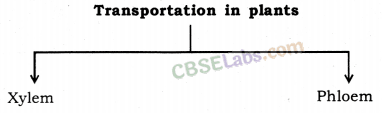
Plants have specialized vascular tissues for transportation of substances. There are two types of vascular tissues in plants.
Xylem:
- Xylem is responsible for transportation of water and minerals. It is composed of trachids, xylem vessels, xylem parenchyma and xylem fibre. Trachids and xylem vessels are the conducting elements. The xylem makes a continuous tube in plants which runs from roots to stem and right up to the veins of leaves.
- Carry water and minerals from the leaves to the other part of the plant.
Phloem:
- Phloem is responsible for transportation of food. Phloem is composed of sieve tubes, companion cells, phloem parenchyma and bast fibers. Sieve tubes are the conducting elements in phloem.
- Carries product of photosynthesis from roots to other part of the plant.
Ascent of sap:
- The upward movement of water and minerals from roots to different plant parts is called ascent of sap. Many factors are at play in ascent of sap and it takes place in many steps. They are explained as follows :
Root pressure:
- The walls of cells of root hairs are very thin. Water from soil enters the root hairs because of osmosis. Root pressure is responsible for movement of water up to the base of the stem.
Capillary action:
- A very fine tube is called capillary, water, or any liquid, rises in the capillary because of physical forces and this phenomenon is called capillary action. Water, in stem, rises up to some height because of capillary action.
Adhesion-cohesion of water molecules:
- Water molecules make a continuous column in the xylem because of forces of adhesion and cohesion among the molecules.
Transpiration pull:
- Loss of water vapour through stomata and lenticels, in plants, is called transpiration.
- Transpiration through stomata creates vacuum which creates a suction, called transpiration pull.
- The transpiration pull sucks the water column from the xylem tubes and thus, water is able to rise to great heights in even the tallest plants.
- Transpiration is the process of loss of water as vapour from aerial parts of the plant.
Functions
- Absorption and upward movement of water and minerals by creating pull.
- Helps in temperature regulation in plant.
Translocation
- Transport of food from leaves (food factory) to different parts of the plant is called Translocation.
Transport of food:
- Transport of food in plants happens because of utilization of energy. Thus, unlike the transport through xylem, it is a form of active transport. Moreover, the flow of substances through phloem takes place in both directions, i.e., it is a two-way traffic in phloem.

Excretion
Excretion in human beings:
- Removal of harmful waste from the body is called excretion.
- Many wastes are produced during various metabolic activities.
- These need to be removed in time because their accumulation in the body can be harmful and even lethal for an organism.
Human Excretory System:
- The human excretory system is composed of a pair of kidneys.
- A tube, called ureter, comes out of each kidney and goes to the urinary bladder.
- Urine is collected in the urinary bladder, from where it is expelled out through urethra as and when required.
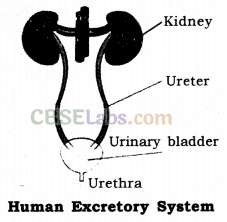
Excretory system of human beings includes :
- A pair of kidneys.
- A urinary bladder.
- A pair of the ureter.
- A urethra.
Kidney:
- Kidney is a bean-shaped organ which lies near the vertebral column in the abdominal cavity.
- The kidney is composed of many filtering units, called nephrons.
- Nephron is called the functional unit of kidney.
Nephron
- It is composed of a tangled mess of tubes and a filtering part, called glomerulus.
- The glomerulus is a network of blood capillaries to which renal artery is attached.
- The artery which takes blood to the glomerulus is called afferent arteriole and the one receiving blood from the glomerulus is called efferent arteriole.
- The glomerulus is enclosed in a capsule like portion, called bowman’s capsule. The bowman’s capsule extends into a fine tube which is highly coiled.
- Tubes from various nephrons converge into collecting duct, which finally goes to the ureter.
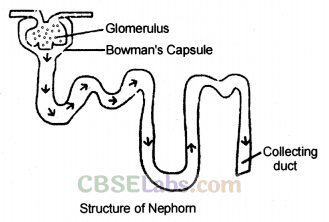
Urine formation in the kidney: The urine formation involves three steps:
-
Glomerular filtration: Nitrogenous wastes, glucose, water, amino acid filter from the blood into bowman’s capsule of the nephron.
-
Tubular reabsorption: Now, useful substances from the filtrate are reabsorbed back by capillaries surrounding the nephron.
-
Secretion: Extra water, salts are secreted into the tubule which opens up into the collecting duct and then into the ureter.
-
Urine produced in the kidneys passes through the ureters into the urinary bladder where it is stored until it is released through the urethra.
-
The purpose of making urine is to filter out waste product from the blood i.e., urea which is produced in the liver.
Haemodialysis: The process of purifying blood by an artificial kidney. It is meant for kidney failure patient.
Excretion in Plants

- Other wastes may be stored in leaves, bark etc. which fall off from the plant.
- Plants excrete some waste into the soil around them.
- Gums, resin → In old xylem
- Some metabolic wastes in the form of crystals of calcium oxalates in the leaves of colocasia and stem of Zamikand.


